
by Bryan Rose
You can always tell how a church thinks about the future by looking at their building.
Some churches approach facilities in the same way a flight-savvy road warrior plans a vacation, well-prepared for the journey and responsive to every travel twist. Others approach facilities like decision-paralyzed dreamers endlessly scrolling travel websites but never actually booking a trip.
During the summer, these two types of travelers, and everyone in-between are visible in most cities. Simply walk around an airport and you will see some families moving purpose: their destination is clear, everyone’s expectations are aligned, and a shared excitement anchors every conversation. Other families spend their entire vacation changing plans, chasing “influencer” recommendations, and arguing over stops. Even worse, some families never leave home at all.
Churches can drift into those same patters, not in how they travel but in how they build.
Over the years, the Auxano church consulting team has been able track four common postures churches take in the movement from vision clarity to our partner Visioneering’s sweet spot of design and construction. We call it the clarity to concrete ‘travel’ tension. This aversion to decision isn’t present in just facility conversations, but in almost every strategic question, vision plan, and overall ministry alignment.
The challenge to move forward is rarely related to only square footage.
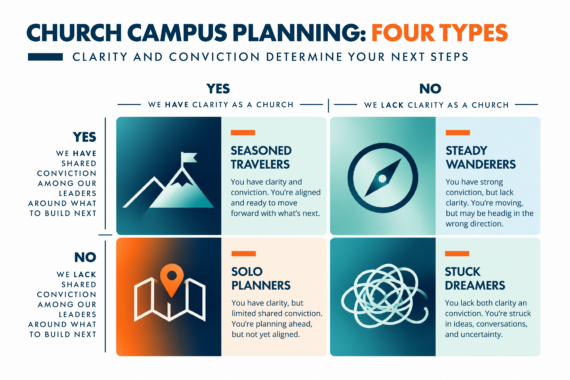
The issue underneath is usually some combination of church vision clarity and shared conviction. In the movement from clarity to concrete (C2C), here are the four leadership types we’ve found:
Seasoned Travelers
This is overall the healthiest posture.
The missional destination is clear, and people are aligned first around where the church is headed and then why it matters to the Kingdom. Decisions are connected to the mission. Conversations about buildings, expansion, parking, kid’s space, or gathering in worship environments are not driven by panic or pressure, but by purpose.
These churches understand something many leaders miss… motion is not the same thing as movement. Busyness does not always result in progress.
The Season Traveler leaders have done the difficult work of clarifying identity, aligning leadership, and creating enough shared ownership that people can move together with confidence.
Interestingly, these churches are not always the fastest-moving churches. But they tend to be the most intentional.
Facilities become depots for disciple-making rather than monuments to maintain. Lobbies become places for family engagement and connection. Campuses begin to reflect the actual ministry philosophy of the church instead of simply revealing decades of disconnected decisions.
C2C Action Step: Gather the church leader team to articulate, in one or two sentences, why your next physical or strategic, capital investment matters missionally. If every answer sounds like the next, celebrate the shared vision clarity and call for sacrificial generosity to accomplish God’s call.
Steady Wanderers
The Steady Wanderer church is active, sincere, and often very, very busy.
There is enough relational unity to keep things moving, but not enough directional clarity to move intentionally.
Programs continue. Ministries operate. Buildings get added. Hallways expand. Rooms get repurposed. Every decision makes a ton of sense in the moment.
But, over time, the campus begins to feel like a newlywed couple’s first apartment… furnished entirely through Facebook Marketplace and family hand-me-downs.
Functional? For sure. Resourceful? Unquestionably. Pieced together? Without a doubt.
Eventually, people can feel the difference between an environment that was intentionally shaped and one that simply accumulated over time.
The problem is never just the hallway. The hallway just exposes the problem.
C2C Action Step: Pause the strategic planning process on your next facility band-aid. Ask your leadership “What picture of a better future are we actually designing for?” Move beyond the next problem to fix and into the discipling the people we are reaching five to ten years from now.
Solo Planners
This may be the most exhausting posture of all.
There is vision clarity somewhere in the past or in the processes, usually shared among staff or key leadership. However, there’s not enough shared conviction for the church to move together.
The strategies exist. The ideas exist. The renderings even exist.
But if no one is following, building for the future eventually starts to feel less like leading and more like taking a walk alone.
These churches often become presentation heavy. Leaders continually refine the message, cast vision again, update diagrams, and clarify details, hoping momentum will finally emerge.
But people rarely support what they were never invited to shape.
This is where many church leaders mistakenly assume the issue is vision communication, when the deeper issue is vision ownership.
C2C Action Step: Stop asking “How can we convince people?” and start asking, “How do we involve people?” Shared conviction grows through personal participation, not polished presentations.
Stuck Dreamers
The Stuck Dreamer loves possibility.
These churches often have a deep heart for people, strong tradition, and genuine aspirations for impact. They talk about reaching the next generation. They talk about community influence. They dream about what could and should be.
But they never actually book the flight.
There is no clear pathway forward and no growing conviction strong enough to create movement.
And over time, dreaming becomes a surrogate for deciding.
Meanwhile, the cost of waiting quietly compounds through deferred maintenance, fragmented spaces, declining engagement, and a growing uncertainty about the future.
C2C Action Step: Remember… momentum rarely begins with a massive leap. It usually begins with one honest conversation and one concrete next step. Ask your team “What’s a small, but significant step we can take to get moving?”
It’s About the Journey
Church facilities are never just about floors, walls, and a roof.
They are physical expressions of the mission, values, strategy, and outcomes that lead to disciple making. Every entrance communicates something. Every gathering space shapes behavior. Every campus either reinforces vision clarity or reveals its absence.
Eventually, every church builds something.
The only question is whether those decisions emerge from intentional vision or accumulated reaction.
People can feel the difference.
They feel when a church is simply making room for more people they hope might attend.
People can also feel when a church has thoughtfully designed environments that support connection, promote disciple-making, fuel hospitality, and create movement.
This is why the most important facilities conversation in your church may not begin with a building committee.
It may begin with your leadership team honestly asking whether you have enough vision clarity and shared conviction to move forward together. It may lead to church consulting conversations.
Because the healthiest churches are not necessarily the ones with the biggest campuses.
They are the ones where clarity has become concrete for people to grow in Christ, together.